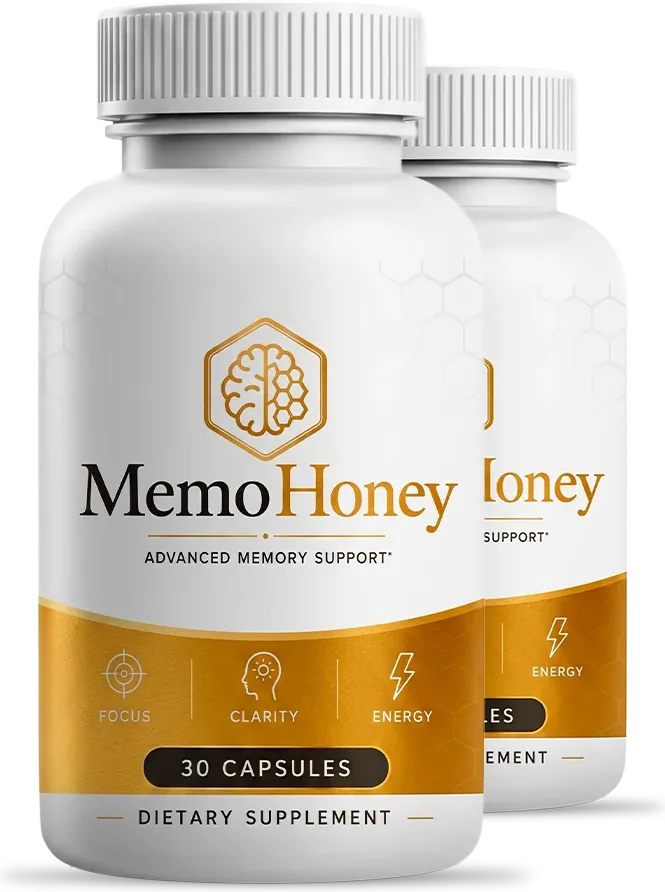
MemoHoney Capsules benefits, as far as anyone can state them honestly, are limited to what is printed on the label: one capsule a day listing niacin, calcium, arginine, citrulline and beta-alanine1. We found no published study of MemoHoney, so no benefit for memory, focus or energy has been shown for this product.
That does not make the label meaningless. This page separates three things that often get blurred: what the seller says on the bottle, what NIH sources say each ingredient has been studied for, and what is actually known about MemoHoney itself. Read it alongside our label walkthrough if you have the bottle in front of you.
01What benefits does the MemoHoney Capsules label claim?
The front label says "ADVANCED MEMORY SUPPORT*" and shows three icons: "FOCUS", "CLARITY" and "ENERGY"1. Those are the only benefit words on the bottle in our photos.
Under FDA rules these are structure/function claims. They must carry the FDA statement, which is why the asterisk is there, and they are not allowed to say a product diagnoses or acts as a medicine for a disease2. The FDA does not approve such claims before a supplement is sold2.
So the label tells you what the seller chose to say. It does not report a measured result, and it does not mean the FDA has looked at the claim.
Notice too what the label does not claim. It says nothing about nitric oxide, blood flow, mood or sleep. If you read about those elsewhere, they are not on the bottle in our photos, and the bottle you receive is what counts.
02Label claim vs public sources vs MemoHoney Capsules: a side-by-side
For each label claim, public sources either say nothing about these ingredients or discuss them for other purposes. And for MemoHoney itself, we found no study at all.
| Label wording | What public sources say | What we know about MemoHoney |
|---|---|---|
| "ADVANCED MEMORY SUPPORT*" | NCCIH: no direct evidence any supplement lowers the chance of dementia | No study found |
| "FOCUS" | NIH sources on these ingredients do not rate them for focus | No study found |
| "CLARITY" | No NIH source we use rates them for clarity | No study found |
| "ENERGY" | Niacin is a B vitamin; arginine, citrulline and beta-alanine are studied mainly in exercise | No study found; no caffeine on the panel |
The middle column is the part most often skipped in sales copy. It is also the part that matters most if you are trying to decide whether a claim has anything behind it.
03What was each MemoHoney Capsules ingredient studied for, according to NIH?
Mostly exercise, blood vessels and basic nutrition. None of the NIH sources we use rates these ingredients for memory.
- Arginine, citrulline and beta-alanine are described mainly in studies of exercise and athletic performance3.
- L-arginine is also discussed for blood-vessel uses, because the body makes nitric oxide from it4.
- Niacin is vitamin B3, an essential nutrient with set daily needs5.
- Calcium is a mineral, listed here at 18 mg, a small amount next to adult needs of 1,000 to 1,200 mg.
Our ingredient pages go into each one: L-arginine, niacin and beta-alanine. Each page sticks to what NIH says and notes where the evidence is about other uses.
04Is the niacin in MemoHoney Capsules a benefit?
It is a plain nutrient fact: one capsule lists 7.5 mg NE of niacin, which the label gives as 47% of the Daily Value1. That is about half of the 16 mg DV.
Niacin is vitamin B3. NIH lists adult needs of 16 mg NE a day for men and 14 mg NE for women, and most people get niacin from foods such as poultry, beef, fish, nuts, legumes and grains5. A 3 oz serving of chicken breast, for example, has about 10.3 mg.
NIH also sets an adult upper limit of 35 mg a day from supplements and fortified foods5. Our arithmetic: 7.5 mg is about 21% of that limit. If you take a multivitamin or fortified drinks, add up the niacin lines. Supplying a share of a nutrient is not the same thing as a memory benefit, and the label's memory wording does not rest on it.
05Does MemoHoney Capsules work? What would show it
Nobody can say, because we found no published study of MemoHoney. Showing that it works would need a study of the product itself.
A useful study would test one capsule a day, the label serving, in people similar to those buying it, against a comparison group. It would say what was measured, for how long, and what side effects appeared. Research on single ingredients at much larger amounts, often in athletes, cannot answer the question for this combination.
Our arithmetic shows how far apart the amounts are. The 400 mg of arginine ingredients per capsule is one fifth of the 2 g low end of amounts NIH describes in studies3, and the 40 mg of beta-alanine is 1/40 of the 1.6 g low end. That comparison does not show the capsules fail; it shows the studies do not describe this product. See how it works for more.
06Why should you read MemoHoney Capsules benefit claims carefully?
Because a benefit word on a label or in an advert is not evidence, and the FTC says so plainly. Health claims need competent and reliable scientific evidence, and testimonials do not substitute for it6.
That standard is useful for any reader. When you see a benefit described for MemoHoney, or any supplement, ask:
- Is this claim about the product itself, or about one ingredient at a much larger amount?
- Was the study in people like me, or in young athletes?
- Is the source a study, or a story from a customer?
- Does the wording sound like a medicine for a disease? Supplements are not allowed to claim that.
Asking these four questions takes a minute. It is the quickest way to tell a well-supported claim from marketing language, whatever the product.
For MemoHoney, the answers point the same way each time: the claims are the seller's words, the research is on single ingredients for other purposes, and the product itself has not been studied.
07What does NCCIH say about memory benefits from any supplement?
NCCIH says supplements are often marketed for memory, yet there is no direct evidence that any supplement lowers the chance of Alzheimer's disease or dementia7. That covers the whole category.
NCCIH also says not to delay seeing a health care provider about memory loss7. Some causes, such as depression, medicine reactions, or thyroid, liver or kidney problems, can be found and managed.
So the most valuable step for anyone worried about memory is a check-up, not a purchase. Our memory page explains NIA's guide to normal forgetfulness and the signs worth raising with a doctor.
08What are the trade-offs to weigh before MemoHoney Capsules?
Weigh the missing evidence and the medicine cautions against your own reasons for trying it. Those two points apply to everyone.
- Evidence: no study of the product exists that we could find.
- Medicines: MedlinePlus says L-arginine interacts with blood pressure medicines, blood thinners, sildenafil, diabetes medicines and potassium-sparing diuretics4.
- Heart: MedlinePlus advises against L-arginine after a recent heart attack.
- Label caution: pregnant or nursing mothers, anyone under 18 and anyone with a known medical condition should consult a physician first.
Ask your doctor or pharmacist before the first capsule, and never change a medicine on your own. Our safety page covers the details.
09If you still decide to buy MemoHoney Capsules, how should you judge it?
Judge it on honest notes and your doctor's view, not on the front label. Keep the bar realistic and the record simple.
Write down why you started, what you hoped to notice, and anything new in sleep, medicines or routine at the same time. Keep the bottle so you can show the panel at appointments. If you feel unwell, stop and contact your doctor; problems with any supplement can be reported to the FDA.
The seller's testimonials are supplied by the seller and not verified by us, and none of them reports a memory test result. If you want to see current pack options, use the button here: See the live price
Bench card
Supplement Facts, line by line
This is the panel printed on the label photo. Tap a line to see what it is, how much one capsule holds, and how that amount compares with figures from NIH sources.
Supplement Facts
Serving Size: 1 Capsule
Servings Per Container: 30
| Ingredient | Amount Per Serving | %DV |
|---|---|---|
| Niacin | 7.5 mg NE | 47% |
| Calcium (as Calcium Carbonate) | 18 mg | 1.5% |
| L-Arginine (base) | 200 mg | ** |
| L-Arginine AKG 2:1 Extract | 200 mg | ** |
| L-Citrulline HCl | 100 mg | ** |
| L-Citrulline Malate | 100 mg | ** |
| Beta Alanine | 40 mg | ** |
** Daily Value (DV) not established.
Other ingredients: Hypromellose (vegetable capsule), vegetable stearate, silicon dioxide.
Amino acid
L-Arginine (base)
200 mg per capsule
An amino acid in meat, poultry, fish and dairy. The body turns it into nitric oxide.
Studies mostly used 2–10 g a day; up to 9 g a day for some weeks appears safe (NIH ODS). MedlinePlus lists heart, blood pressure and medicine cautions.
10% of 2,000 mg, low end of studied amounts (our arithmetic)
Panel transcribed from the label photo supplied by the site owner. Comparisons are our arithmetic from NIH figures; they say nothing about what one capsule does for you, and no study of MemoHoney exists that we could find.
Against studied amounts and Daily Values, niacin is the only line near half; the amino acids sit at 20% or less.
Bench card
Label decoder: every line on the bottle, front and back
Tap a line to see what it means in plain words, and whether it is a fact printed on the label or the seller's own wording.
"ADVANCED MEMORY SUPPORT*"
Means: the seller's main claim
Structure/function wording. The asterisk points to the FDA statement; the FDA does not review such claims before sale.
Seller's wording
Transcribed from the label-wrap photo. Read the bottle you receive; if a line differs, ask the order desk before use.
Safety: MemoHoney is sold for adults. Its label lists L-arginine, L-citrulline, beta-alanine, niacin and calcium, and says that pregnant or nursing women, anyone under 18 and anyone with a known medical condition should consult a physician first. Ask your doctor or pharmacist before use if you had a recent heart attack, take blood pressure medicine, a blood thinner or any other medicine, have kidney disease or have surgery planned. Never change a prescribed medicine on your own. Memory changes that worry you deserve a doctor visit first, because many causes can be found and dealt with.
Frequently asked questions
What are the benefits of MemoHoney for memory?
None has been shown, because we found no published study of MemoHoney. The "ADVANCED MEMORY SUPPORT*" line is the seller's structure/function wording, which the FDA does not approve before sale.
Is there evidence MemoHoney will work for me?
No one can say yet, because the product has not been studied as far as we could find. NIH sources discuss its ingredients mainly for exercise, blood vessels and nutrition, not memory.
Are there focus benefits from MemoHoney?
The front label shows a "FOCUS" icon, but that is the seller's wording. The NIH sources we use do not rate any of the panel ingredients for focus.
Does MemoHoney give energy benefits?
We cannot say it does. The "ENERGY" icon is a label word; the panel lists no caffeine, and its niacin is a B vitamin listed at 47% of the Daily Value.
Do MemoHoney benefits depend on when I take the capsule?
No benefit has been shown, so timing cannot be linked to one. The label says to take one capsule daily with 8 oz of water, for best results 20 to 30 minutes before a meal, or as your healthcare professional directs.
Is MemoHoney Capsules good value?
Value depends on what you expect, and no study shows what the capsules do. For current pack prices, see our pricing page and confirm the total at the live checkout before you pay.