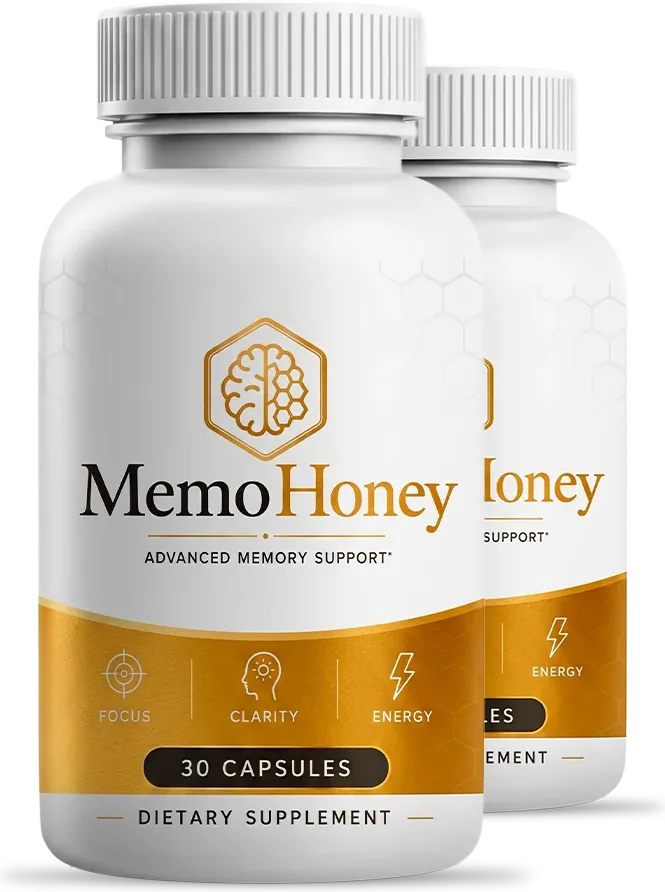
MemoHoney Capsules and focus come together on the front of the bottle, where three small icons read "FOCUS", "CLARITY" and "ENERGY"1. Those words are the seller's own labelling. We found no study of MemoHoney, so we cannot say the capsules change focus, concentration, clarity or energy.
This page explains what those icons are, why "brain fog" is a description rather than a diagnosis, which everyday factors NIA ties to memory and thinking, and how to keep notes that make a doctor visit more useful. It is written for anyone who feels foggy or scattered and wants a calm, honest starting point.
01What do the FOCUS, CLARITY and ENERGY icons on MemoHoney Capsules mean?
They are the seller's structure/function wording, printed beside the line "ADVANCED MEMORY SUPPORT*" on the front label1. They describe what the seller wants to say, not what a study measured.
Under FDA rules, structure/function claims on supplements must carry the FDA statement, and they cannot claim to diagnose a disease or act as a medicine for one2. The FDA does not approve these claims before a product goes on sale2. That is why the asterisk appears: it points to the printed statement on the back panel.
So when you see "FOCUS" on the bottle, read it as a label word. It is not a test result, and it is not something we can confirm.
02What is on the MemoHoney Capsules panel, and is any of it rated for focus?
The panel lists niacin, calcium, two arginine lines, two citrulline lines and beta-alanine, at one capsule a day1. None of the NIH sources we use rates these ingredients for focus or concentration.
| Panel line (per capsule) | Amount | Where NIH sources mainly discuss it |
|---|---|---|
| Niacin | 7.5 mg NE (47% DV) | A B vitamin; nutrient needs |
| Calcium (as calcium carbonate) | 18 mg | A mineral; nutrient needs |
| L-Arginine (base) and L-Arginine AKG 2:1 Extract | 200 mg each | Exercise studies; blood-vessel uses |
| L-Citrulline HCl and L-Citrulline Malate | 100 mg each | Exercise studies |
| Beta Alanine | 40 mg | Exercise studies |
Each line has its own page if you want detail, starting with our ingredients overview. The honest summary is short: the research context for these ingredients is exercise and nutrition, not attention.
03Is "brain fog" a diagnosis?
No. "Brain fog" is an everyday phrase people use for feeling slow, scattered or forgetful. It is not a medical diagnosis, and it can have many different causes.
That matters for MemoHoney Capsules readers because a vague feeling invites a vague fix. Two people who both say "foggy" might have quite different things going on: one sleeps five hours a night, another started a new medicine, a third is low on vitamin B12. The words are the same; the reasons are not.
Feeling foggy now and then, after a poor night or a busy week, is common. What deserves attention is fog that lasts, keeps getting worse, or comes with other changes such as trouble following conversations or managing bills.
Sales copy for many supplements uses the phrase freely. We do not, because naming a feeling is not the same as knowing what is behind it. The useful question is not "which product?" but "what changed, and when?"
04Which everyday factors does NIA link with memory and thinking?
NIA lists several common, often manageable causes of memory and thinking problems, and many of them are part of ordinary life3. A doctor can look into each one.
- Sleep problems. NIA says older adults need about 7 to 9 hours, and poor sleep can bring forgetfulness4.
- Medicines. Side effects of medicines are on NIA's list of causes3.
- Stress, depression and anxiety. These can affect how clearly you think day to day.
- Alcohol. Alcohol misuse is one of the causes NIA names.
- Nutrition. Low vitamin B12 and a poor diet are on the list too.
- Thyroid, kidney or liver problems. These need a doctor and simple tests.
NCCIH makes the same point from the supplement side: treatable causes such as depression, medicine reactions and thyroid, liver or kidney problems should be checked by a provider5.
05How do medicines and supplements fit into foggy days?
Keep one written list of every medicine and supplement you take, and share it with your doctors and pharmacists, as NIA advises6. Combinations, not single items, are often what a pharmacist spots.
For older adults especially, several prescriptions plus over-the-counter products can add up. A list helps your care team see the whole picture, including when each item was started. If you take MemoHoney Capsules, write it down with the amount printed on the label: one capsule a day.
Do not stop or change a prescription because you feel foggy. Bring the concern to the person who prescribed it. Our medicines page lists the groups of medicines that call for a check before taking MemoHoney, such as blood pressure medicine and blood thinners.
06What should you track before talking to a doctor about focus?
Track a simple two-week diary of sleep, energy, focus and anything new. Patterns on paper are far easier to discuss than a general sense of fog.
- Bedtime, wake time and how rested you felt.
- Times of day when concentration was hardest.
- Caffeine and alcohol, roughly how much and when.
- New medicines, supplements or dose changes, with dates.
- Big stresses, illness or changes in routine.
- Any specific slips, such as missed appointments or lost words.
Keep the notes short and honest; a few words a day is enough. Bring the diary to your appointment along with your medicine list. If something feels sudden or severe, such as new confusion, do not wait for two weeks of notes; our warning signs page explains when to seek help quickly.
07If you feel sharper after starting MemoHoney Capsules, what does that show?
On its own, very little. A good week can follow a new supplement for many reasons that have nothing to do with the capsules, and one person's experience cannot separate them.
Think about what else often changes at the same time. People who start a new routine may also go to bed earlier, drink more water, cut back on alcohol or simply pay closer attention to how they feel. Stressful periods end. Colds clear. Seasons change and so does daylight. Any of these can shift how focused you feel.
This is why studies use comparison groups and why the FTC expects health claims to rest on sound scientific evidence rather than personal stories. We found no such study for MemoHoney. If you keep a diary, it is still worth doing: it gives your doctor real information, even if it cannot tell you what caused a change.
08Can MemoHoney Capsules be compared with coffee or energy products?
Not on the evidence we have. The MemoHoney panel lists no caffeine, and we have no study measuring energy or alertness from the capsules1. Any comparison of effects would be invented.
It is also worth knowing that tiredness has its own list of everyday causes. Short or broken sleep, long gaps between meals, low activity, worry and some medicines can all leave you feeling flat. Those are the same areas a doctor will ask about, so they are worth noting before you reach for any product marketed with the word energy.
What you can compare is the label. The MemoHoney panel prints exact amounts for each line and a clear serving: one capsule a day with an 8 oz glass of water. If you also drink coffee or take another product, look at each label for overlapping ingredients, especially niacin, which turns up in many multivitamins and fortified foods.
Our comparison page shows how to read two labels side by side without guessing at what either one does.
09If you decide to try MemoHoney Capsules, what is the sensible order?
Doctor or pharmacist first, then the label's directions, then honest notes. That order keeps a supplement from hiding a cause that needs attention.
Ask before the first capsule if you have heart disease or had a recent heart attack, take blood pressure medicine, a blood thinner, sildenafil, a potassium-sparing diuretic, diabetes or tuberculosis medicine, have kidney or liver disease, have surgery planned, are pregnant or nursing, or are under 18. Our safety page covers the details, and how to use walks through the label's directions.
If you go ahead, you can check the current pack prices here: See the live price
Almanac card
Forgetfulness: normal aging, or a reason to see a doctor?
Ten examples from the National Institute on Aging. Sort each one, then see how NIA files it. This is a reading aid, not a test, and it does not diagnose anything.
Making poor judgments and decisions a lot of the time
Forgetting which day it is and remembering it later
Trouble having a conversation
Making a bad decision once in a while
Misplacing things often and being unable to find them
Missing a monthly payment
Losing track of the date or time of year
Losing things from time to time
Problems taking care of monthly bills
Sometimes forgetting which word to use
0 of 10 sorted
Source: NIA, Memory Problems, Forgetfulness, and Aging. NIA advises seeing a doctor about noticeable memory changes or problems lasting more than a few weeks; many causes, such as medicine side effects, sleep problems, thyroid problems or low vitamin B12, can be dealt with.
Safety: MemoHoney is sold for adults. Its label lists L-arginine, L-citrulline, beta-alanine, niacin and calcium, and says that pregnant or nursing women, anyone under 18 and anyone with a known medical condition should consult a physician first. Ask your doctor or pharmacist before use if you had a recent heart attack, take blood pressure medicine, a blood thinner or any other medicine, have kidney disease or have surgery planned. Never change a prescribed medicine on your own. Memory changes that worry you deserve a doctor visit first, because many causes can be found and dealt with.
Frequently asked questions
What does the CLARITY icon on MemoHoney refer to?
It is one of three front-label icons the seller chose, alongside "FOCUS" and "ENERGY". The FDA does not approve this kind of structure/function wording before a product is sold.
Is MemoHoney meant for focus at work or school?
The front label prints a "FOCUS" icon, but that is the seller's wording and we found no study of MemoHoney. The label also asks anyone under 18 to consult a physician before using it.
Is MemoHoney a fix for brain fog?
We cannot say that it will, because the product has not been studied. Brain fog is not a diagnosis, and common causes such as poor sleep, medicine side effects or low vitamin B12 are worth checking with a doctor.
Does MemoHoney contain caffeine for energy?
No caffeine appears on the Supplement Facts panel in our label photo. The "ENERGY" icon on the front is a label word from the seller, not a measured result.
How long should I wait to judge MemoHoney for concentration?
We cannot give a timeframe, because no study of MemoHoney exists that we could find. If concentration problems last more than a few weeks, NIA's general advice is to see a doctor rather than wait on any product.
Can MemoHoney stand in for a doctor visit about poor concentration?
No. Poor concentration that lasts or gets in the way of daily life should be checked by a doctor, who can look at sleep, medicines, mood, nutrition and thyroid health.