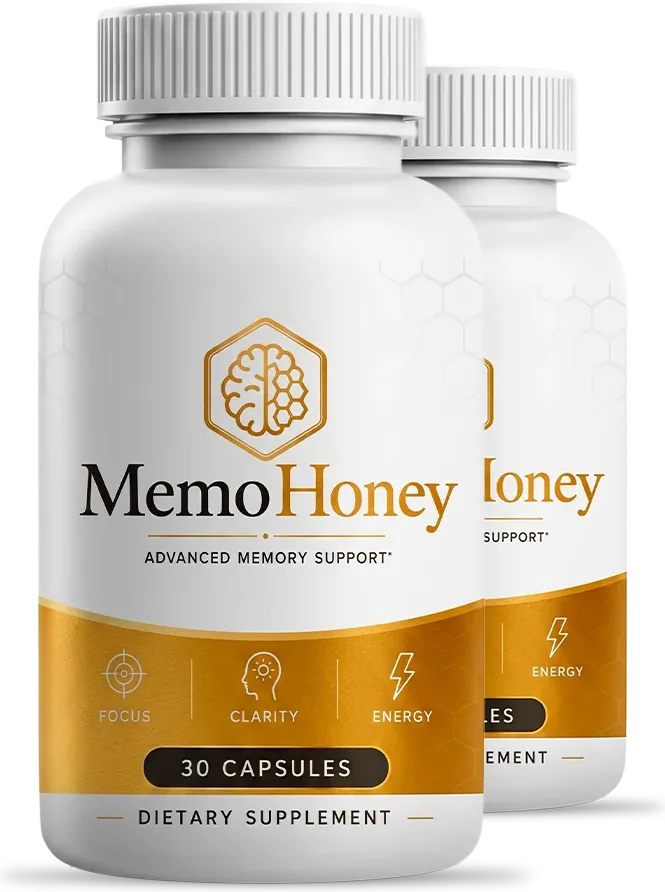
How does MemoHoney Capsules work? The honest answer is that no one can say, because we found no published study of the product, and a mechanism cannot be shown without one. What the bottle offers is a label: one capsule a day listing niacin, calcium, arginine, citrulline and beta-alanine, with the front-label wording "ADVANCED MEMORY SUPPORT*"1.
This page explains the idea the label seems to rest on, what is known about how the body uses these ingredients in general, why that general science is not the same as a mechanism for this product, and what the FDA and FTC require before claims like these can be trusted.
01What idea does the MemoHoney Capsules label put forward?
The label pairs memory wording with an amino-acid panel, but it does not explain any mechanism. It prints "ADVANCED MEMORY SUPPORT*" and icons reading "FOCUS", "CLARITY" and "ENERGY"1.
Nowhere on the bottle in our photos does it say how those words connect to the ingredients. It does not mention nitric oxide, blood flow or the brain. Any explanation of how the capsules are meant to work comes from outside the label, and we do not repeat sales-page explanations here.
What we can read is the panel, and that is where the rest of this page starts. Our label page shows every line in full.
02What is in one MemoHoney Capsules serving?
One capsule is one serving, and the bottle holds 301. The panel lists seven lines.
| Line | Per capsule | General role in the body (NIH sources) |
|---|---|---|
| Niacin | 7.5 mg NE | Vitamin B3, an essential nutrient |
| Calcium (as calcium carbonate) | 18 mg | A mineral |
| L-Arginine (base) | 200 mg | Amino acid the body turns into nitric oxide |
| L-Arginine AKG 2:1 Extract | 200 mg | A compound containing arginine |
| L-Citrulline HCl | 100 mg | Amino acid converted to arginine |
| L-Citrulline Malate | 100 mg | Amino acid converted to arginine |
| Beta Alanine | 40 mg | Amino acid that forms carnosine in muscle |
Our arithmetic: the seven lines add up to 765.5 mg per capsule. The third column describes what NIH says about each ingredient in general; it is not a claim about the capsules.
03What does the nitric oxide background of MemoHoney Capsules' amino acids mean?
It means arginine and citrulline sit on a known pathway in the body, not that MemoHoney acts through it. MedlinePlus says the body turns L-arginine into nitric oxide, which widens blood vessels2.
NIH says about 80% of citrulline is converted to arginine in the kidneys3. NIH also notes that arginine is in red meat, poultry, fish and dairy, with a typical diet supplying about 4 to 5 g a day3. So this pathway is busy every day with arginine from food.
Knowing a pathway exists is only the first step. A mechanism claim would also need to show that the product, at its amount, changes that pathway in people, and that the change links to the outcome claimed. Neither has been shown for MemoHoney. Our nitric oxide page covers this background in more detail.
04Where do niacin and beta-alanine fit in MemoHoney Capsules?
Niacin is a vitamin and beta-alanine is an amino acid studied in hard exercise; neither is described by NIH as working on memory. Both appear on the panel at modest amounts1.
Niacin is vitamin B3, which the body needs for normal function. Severe deficiency, called pellagra, can include memory loss, but that is about lacking the vitamin, not about taking extra. Most people get enough niacin from food.
Beta-alanine is a precursor to carnosine, which helps buffer acid in muscles during hard exercise3. It is studied at 1.6 to 6.4 g a day. Our arithmetic: the 40 mg on the label is 1/40 of the 1.6 g low end. See our beta-alanine page for the research context.
05Why can't ingredient studies be scaled down to MemoHoney Capsules?
Because results at one amount do not tell you what happens at a much smaller one, or in a mix of several ingredients. Each step away from the studied conditions adds uncertainty.
Look at the gaps, using our arithmetic and NIH's figures3:
- Arginine studies mostly used 2 to 10 g a day; the label lists 400 mg of arginine ingredients, one fifth of the low end.
- The lowest citrulline example NIH gives is 1.35 g a day; the label lists 200 mg of citrulline ingredients, about 15% of it.
- Beta-alanine was studied at 1.6 to 6.4 g a day; the label lists 40 mg.
Most of those studies also looked at exercise, not memory, and many involved active adults rather than older people. The people, the amounts and the outcomes all differ.
None of this shows that the capsules do nothing. It shows that the existing research was not designed to answer questions about this product, so it cannot be borrowed to explain how MemoHoney works.
06What would a real mechanism claim for MemoHoney Capsules need?
It would need studies of MemoHoney itself, at one capsule a day, in people. Science about single ingredients at much larger doses cannot fill that gap.
A sound chain of evidence would usually include:
- A clear statement of what the product is supposed to change.
- Measurements showing that change after people take the product at the label amount.
- A comparison group taking a look-alike capsule, so expectation and chance can be ruled out.
- A link between that change and a real outcome people care about, such as memory in daily life.
- Reported side effects and dropouts.
We found no published work for MemoHoney covering any of these steps. That is the reason this page cannot describe a mechanism.
If a study is published, these same steps are a good way to read it. Check who paid for it, how many people took part, how long it ran, and whether the capsule used matches the label you are holding. A small, short study with no comparison group would tell you far less than its headline suggests.
07What do FDA rules say about claims like MemoHoney Capsules' label?
The FDA classes wording like "ADVANCED MEMORY SUPPORT*" as a structure/function claim, which must carry the FDA statement and cannot claim to diagnose or act as a medicine for a disease4.
The key point for readers is what the FDA does not do. It does not approve structure/function claims before a supplement goes on sale4. The seller is responsible for the wording; the asterisk simply points to the statement printed on the back panel.
So the presence of an FDA statement on a bottle is not a sign of FDA review. It is a sign that the label contains a claim the FDA has not evaluated.
The same rules explain why careful writers avoid saying a supplement acts on a disease such as dementia. Supplements are not medicines, and a label that drifted into disease language would be outside what the rules allow.
08What does the FTC expect behind health claims?
The FTC says health claims need competent and reliable scientific evidence, and that testimonials do not substitute for it5. That applies to adverts, websites and other marketing for supplements.
This is a helpful standard when you read anything about how a product works. Ask whether the explanation cites studies of the product, or only general biology and customer stories. For MemoHoney, the seller supplies testimonials, which we have not verified, and none of them reports a memory test result.
- General biology tells you what an ingredient can do in the body under some conditions.
- A product study tells you what the product did in people.
- A testimonial tells you one person's view, with no comparison.
Only the middle kind could show how MemoHoney works, and we found none.
09If you are considering MemoHoney Capsules, what is the practical takeaway?
Think of it as an unstudied product with a clear label, and put any memory concern in front of a doctor first. That keeps expectations realistic and safety first.
Arginine brings specific cautions: MedlinePlus lists interactions with blood pressure medicines, blood thinners, sildenafil, diabetes medicines and potassium-sparing diuretics, and advises against L-arginine after a recent heart attack2. Ask your doctor or pharmacist before the first capsule, and do not change any medicine on your own. Our safety page lists the details.
If you decide to go ahead, follow the label's one-a-day serving, explained on our how to use page. Current pack options are here: See the live price
Bench card
Supplement Facts, line by line
This is the panel printed on the label photo. Tap a line to see what it is, how much one capsule holds, and how that amount compares with figures from NIH sources.
Supplement Facts
Serving Size: 1 Capsule
Servings Per Container: 30
| Ingredient | Amount Per Serving | %DV |
|---|---|---|
| Niacin | 7.5 mg NE | 47% |
| Calcium (as Calcium Carbonate) | 18 mg | 1.5% |
| L-Arginine (base) | 200 mg | ** |
| L-Arginine AKG 2:1 Extract | 200 mg | ** |
| L-Citrulline HCl | 100 mg | ** |
| L-Citrulline Malate | 100 mg | ** |
| Beta Alanine | 40 mg | ** |
** Daily Value (DV) not established.
Other ingredients: Hypromellose (vegetable capsule), vegetable stearate, silicon dioxide.
Amino acid
L-Arginine (base)
200 mg per capsule
An amino acid in meat, poultry, fish and dairy. The body turns it into nitric oxide.
Studies mostly used 2–10 g a day; up to 9 g a day for some weeks appears safe (NIH ODS). MedlinePlus lists heart, blood pressure and medicine cautions.
10% of 2,000 mg, low end of studied amounts (our arithmetic)
Panel transcribed from the label photo supplied by the site owner. Comparisons are our arithmetic from NIH figures; they say nothing about what one capsule does for you, and no study of MemoHoney exists that we could find.
Against studied amounts and Daily Values, niacin is the only line near half; the amino acids sit at 20% or less.
- Printed facts (10)
- Seller's wording (3)
- Not in photos (1)
Safety: MemoHoney is sold for adults. Its label lists L-arginine, L-citrulline, beta-alanine, niacin and calcium, and says that pregnant or nursing women, anyone under 18 and anyone with a known medical condition should consult a physician first. Ask your doctor or pharmacist before use if you had a recent heart attack, take blood pressure medicine, a blood thinner or any other medicine, have kidney disease or have surgery planned. Never change a prescribed medicine on your own. Memory changes that worry you deserve a doctor visit first, because many causes can be found and dealt with.
Frequently asked questions
How does MemoHoney work in the body?
No one can say, because we found no published study of MemoHoney. Its panel lists ingredients with known general roles, such as arginine in nitric oxide production, but that is not evidence about the product.
What is the mechanism behind MemoHoney?
The label does not describe one. A mechanism would need studies showing that one capsule a day changes something measurable in people, and we found none.
Is there science behind MemoHoney's ingredients?
There is general science on the ingredients, mostly about exercise, blood vessels and nutrition. None of the NIH sources we use rates them for memory, and none studied MemoHoney itself.
Have any studies tested MemoHoney Capsules?
We searched and found no published study of MemoHoney Capsules. If one appears, we will look at who took part, the amount used and what was measured.
Does the science on arginine apply to MemoHoney's amounts?
Not directly. NIH describes arginine studies mostly at 2 to 10 g a day, while one capsule lists 400 mg of arginine ingredients, so those studies do not describe this product.
Has MemoHoney been through a clinical trial?
We found no clinical trial of MemoHoney. The front-label wording is a structure/function claim, which the FDA does not approve before sale.